
World Cup 2026 Schedule, Hosts & Cities
By Jangul Aslam · Published 2026-06-19
It's on right now. My son Adiv and I have had matches running every evening, and somewhere in the first week we kept asking the same questions: who's actually hosting this thing? How many teams now? When's the final? Where on earth is that city?
So I pinned it all in one place — the schedule, the hosts, every host city, and how the new format works. No hype, just the lay of the land for anyone following the 2026 World Cup with their kids. Then, because that's what we do here, a few free games to actually learn the world it's spread across.
Who's hosting the 2026 World Cup?
For the first time ever, three countries are co-hosting: the United States, Canada and Mexico. No World Cup has ever been shared by three nations before.
It's also the biggest World Cup in history by a wide margin — 48 teams (up from 32), 104 matches (up from 64), played across 16 host cities spanning a whole continent. The tournament opened in Mexico City, at the historic Estadio Azteca, and the final is on 19 July at the New York/New Jersey stadium (MetLife).
All 16 host cities, by country
Eleven cities are in the US, three in Mexico, two in Canada. Here's the full list, grouped:
United States — 11 cities
- Atlanta
- Boston
- Dallas
- Houston
- Kansas City
- Los Angeles
- Miami
- New York/New Jersey
- Philadelphia
- San Francisco Bay Area
- Seattle
Mexico — 3 cities
- Mexico City
- Guadalajara
- Monterrey
Canada — 2 cities
- Toronto
- Vancouver
It stretches from Boston on the US east coast all the way to Vancouver on Canada's west, and down to Guadalajara in central Mexico. That's the bit that surprised us most: this isn't a tournament in one country, it's a month-long tour of a continent. Spinning between those cities on Globe Trek is how Adiv got them straight.
World Cup 2026 schedule: round by round
The tournament runs from 11 June to 19 July 2026 — about five and a half weeks. Here's how the month breaks down stage by stage:
| Stage | Dates (2026) |
|---|---|
| Group stage | 11 – 27 June |
| Round of 32 | 28 June – 3 July |
| Round of 16 | 4 – 7 July |
| Quarter-finals | 9 – 11 July |
| Semi-finals | 14 – 15 July |
| Third-place play-off | 18 July |
| Final | 19 July |
If you only remember two dates: it opened on 11 June in Mexico City, and the final is Sunday 19 July in New York/New Jersey.
The new 48-team format, explained simply
This is the part that's genuinely changed since the last World Cup, so it's worth getting right.
The 48 teams are drawn into 12 groups of four. Each team plays the other three in its group once. Then:
- The top two teams from each group advance — that's 24 teams.
- Plus the eight best third-placed teams across all groups — that's 8 more.
That gives 32 teams for a brand-new Round of 32, and from there it's straight knockout — Round of 16, quarter-finals, semis, and the final. The short version: more teams, more groups, and a new extra round before the old knockout bracket kicks in.
Where the teams stay: base camps
Here's a layer most people never think about. Every squad sets up a "base camp" — its home-away-from-home: a training ground plus a team hotel where players sleep, train and recover between matches. For 2026 they're scattered across all three host nations, and a few caught our eye:
- Kansas City is a quiet hub — the defending champions Argentina, plus England and the Netherlands, all based themselves in and around it.
- Brazil set up in New Jersey, close to the final venue.
- Texas drew a cluster — Sweden and Czechia both based near Dallas, with DR Congo down in Houston.
- The most unusual call was Iran's. Originally slated for Tucson, Arizona, their base was moved across the border to Tijuana, Mexico — over security concerns. So Iran trains in one host country while its group games happen just up the coast in the US.
It's a whole second map laid over the tournament: not just where the matches are played, but where 48 nations are quietly living for a month. (Finding all of their home countries is what Soccer Globe Hunt turns into a game.)
How many people are watching?
A lot. FIFA reported that around 5 billion people engaged with the 2022 World Cup in Qatar — the most-followed edition ever — with roughly 1.5 billion tuning in for the final alone. The 2018 tournament drew about 3.5 billion television viewers. It's the closest thing we have to the whole world watching one event together — which is exactly why it's such a good moment to learn the world behind it.
Want to actually learn this world? Play it
A team you've never heard of beats a favourite, a host city you can't place flashes up on screen — and it all washes past unless you do something with it. That's the gap we built these little games to fill. They're free, no ads, no sign-up, and they run in any browser:
- Flag Guess — see a flag, name the country. The fastest way we've found to stop confusing one red-white-and-blue flag for another. After a week of this, the teams walking out make a lot more sense.
- Globe Trek — spin a real 3D globe and tap the country you're asked to find. You learn where places actually are — not "somewhere in Europe," but the exact spot, next to which neighbours.
- Soccer Cup Quest — the all-rounder World Cup quiz. Who hosted, who won, the final score, the top scorer, working back through the editions.
- Soccer Globe Hunt — the same 3D globe, now finding the host nations. Where was 1950? Where is 2026? Spin and tap.
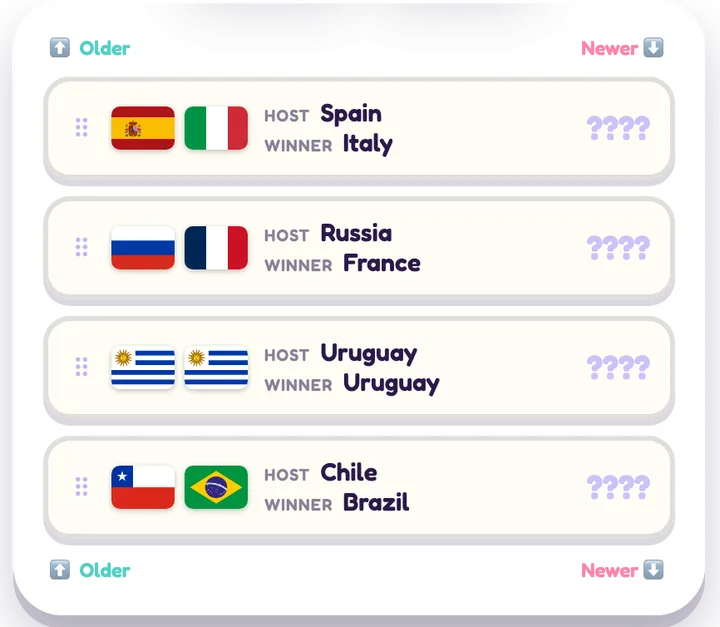
- Soccer Cup Timeline — drag the editions into the right order, oldest to newest. It rewires how you picture the whole history end to end.
The first two live in our geography games hub and work all year round; the soccer set lives in the sports games hub. Everything runs on facts and flags only — no logos, no badges, just the countries themselves. (A small detail we're careful about: England plays as England, with the St George's Cross, because in football the United Kingdom doesn't field one team — England, Scotland, Wales and Northern Ireland each have their own.)
Quick answers about the 2026 World Cup
Who is hosting the 2026 World Cup? The United States, Canada and Mexico — the first World Cup ever shared by three countries, spread across 16 host cities (11 in the US, 3 in Mexico, 2 in Canada).
How many teams and host cities are there? A record 48 teams (up from 32) play 104 matches across 16 host cities — the largest World Cup in history.
When is the 2026 World Cup final? Sunday 19 July 2026, at the New York/New Jersey stadium (MetLife). The tournament opened on 11 June in Mexico City and runs about five and a half weeks.
How does the new 48-team format work? Twelve groups of four. The top two from each group, plus the eight best third-placed teams, advance to a new Round of 32 — then straight knockout to the final.
Are there free games to learn the World Cup's flags and cities? Yes. Our sports games and geography games hubs are free, with no ads and no sign-up — start with Flag Guess and Soccer Cup Quest, or browse all 33 free games.
Watch it, then keep it
The World Cup only comes round every four years, and it pours the whole map of the world onto your screen for a month. These games are our small way of keeping a bit of it — the flags, the countries, the host cities — turned into a quick puzzle the kids would play on the bus anyway.
Everything on iplay.free is free, with no ads, no sign-up and no download, in 12 languages. During the tournament it's a brilliant half-time activity; long after the final, it's still a solid geography workout.
— Jangul & Adiv