
Best Free No-Ad Games for Kids Ages 4-6
By Jangul Aslam · Published 2026-06-07

For the youngest kids, ad-free isn't a nice-to-have — it matters most of all. A four-year-old will happily tap anything that moves on the screen, and a pop-up ad is exactly the kind of thing they'll mis-tap straight into something you never wanted them near. Older kids learn to ignore the banner and close the interstitial; a pre-reader has no idea what they're looking at. They can't read the "skip ad" label, can't tell a game button from an ad button, and won't think twice before tapping a flashing one. The fix is simple: don't have ads at all.
Every game on iplay.free plays instantly in the browser — no ads, no sign-up, no download, nothing to buy, and no reading required to start. Nothing pops up between rounds, nothing asks for an email, and there's no "create an account to continue" wall to stop a small child in their tracks. That's the whole point of this shortlist for ages 4 to 6: games you can open and hand straight to your kid without hovering over their shoulder.
What makes a game right for ages 4-6
Most "kids' games" lists ignore how different a four-year-old is from an eight-year-old. At this age a game has to make sense without a single word of instruction, and it has to stay calm — a child who gets a scary "you lose" screen or a ticking clock will just put the tablet down. Before the picks, here's what we actually look for. A good game for a pre-reader is:
- No reading needed — a child should understand it from what's on the screen, not from a tutorial they can't read. Colours, shapes and pictures do the explaining.
- Forgiving — no harsh "game over," no losing-a-life sting, no flashing red. A wrong move just resets quietly, and they try again with no drama.
- No time pressure — no countdown clock to panic about. A child can stare at the board for a minute, get distracted, come back, and nothing is lost.
- Big tap targets — large, obvious things to touch, sized for small fingers on a phone or tablet, so a near-miss still lands.
- Short loops — a round that starts and finishes in a minute or two, so a win always feels close and stopping is easy when it's time to stop.
All the picks below are built around those boxes, and where one bends a rule, we say exactly how. Because there are no ads in the mix, there's nothing on screen competing for those small fingers.
The picks for ages 4-6
Memory Match — great from age 4 up
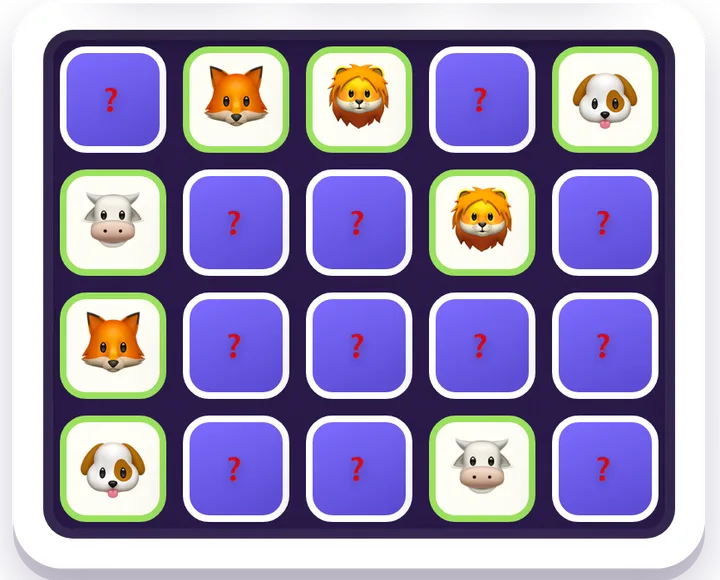
Memory Match is the classic concentration game: flip two cards face-up, find the matching pair, and clear the board. There's nothing to read, nothing counts down and you can't lose — a little clock just counts up in the corner, and a child keeps flipping until everything matches, so every game ends in a win. The gentle skill here is pure recall: remembering where the matching picture was a moment ago. You can almost watch it happen the first time a four-year-old turns over a card and you see them think, "I've seen that one." It's about the simplest first game there is, the cards are big and easy to tap, and it's a genuinely satisfying one to get right. Start small and it grows naturally as their memory does.
Simon — great from age 5 up
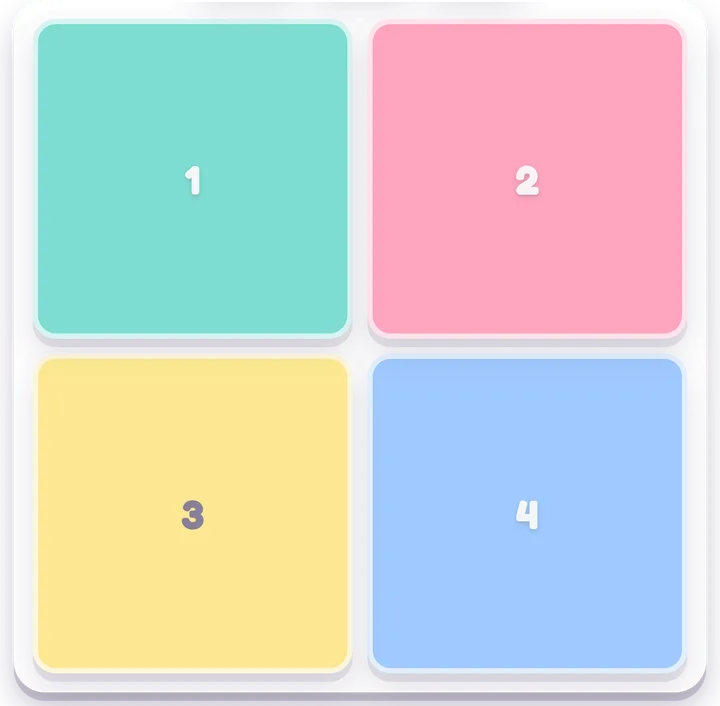
Simon lights up a colour, then asks your child to tap it back. Then it adds a second colour, then a third, and the sequence grows one step at a time. Watch, remember, repeat — that's the whole game. It quietly builds sequence memory, which is the same skill behind following a two- or three-step instruction at home ("get your shoes, then your coat, then meet me at the door"). The big coloured panels make perfect tap targets, the lights and sounds make it feel like a toy rather than a test, and there's nothing at all to read. Get the sequence wrong and it simply starts over — no penalty, no scary screen.
Snake — great from age 5 up
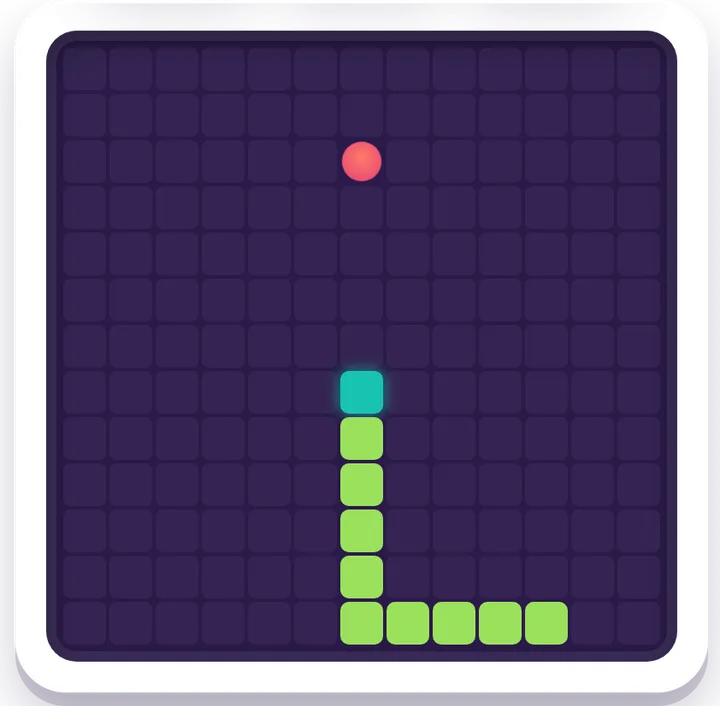
Snake is a kid's first taste of being in control of something on screen. Steer the snake around to eat dots and watch it grow longer — that's the whole idea. The skill is simple control plus a little forward planning: keep going and you'll start thinking one step ahead so you don't steer into your own tail. Running into a wall or its own tail does end the round — that's the one rule it bends — but turning on Pass through walls in Settings takes the walls out of it. It's a calm introduction to directional controls, and because the rounds are short, a fresh start is never far away — a four- or five-year-old can pick it up, lose interest, and come back in a minute without any sense of failure. It's the kind of game a young child can quietly improve at without anyone making a fuss about scores.
Bubble Shooter — great from age 5 up
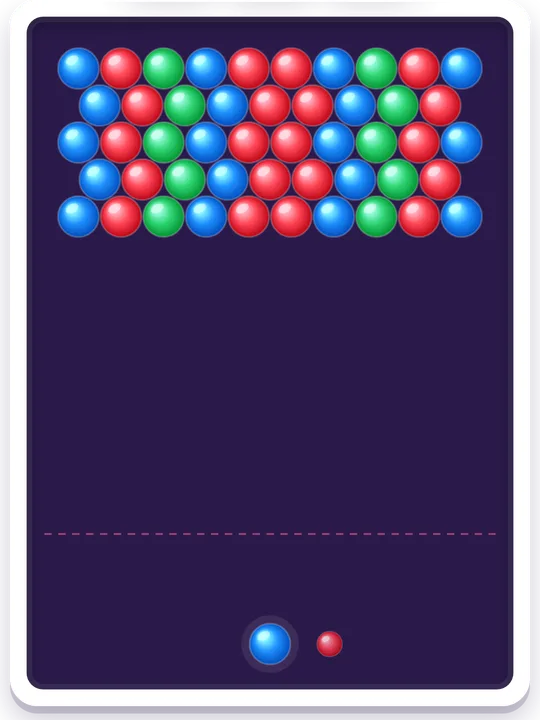
Bubble Shooter lets your child aim a bubble at a cluster of matching colours and pop a whole group at once — which is enormously satisfying when you're five. Aiming and releasing is a perfect early skill: it builds simple hand-eye coordination and the small but real idea of lining something up before you act. The bubbles are big and brightly coloured, so they're easy targets for small fingers, and there's no clock racing you and no way to fall behind. Match colours, watch them burst, repeat — it's instantly readable without a word of explanation, which is exactly what you want at this age.
Tangram — great from age 5 up
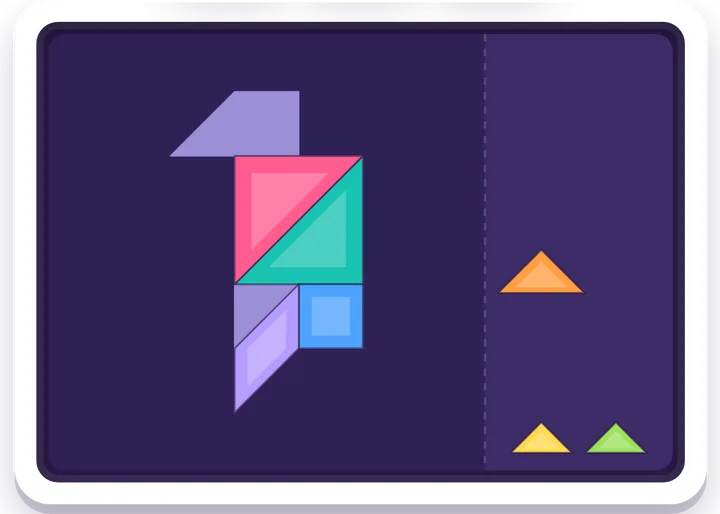
Tangram is the classic seven-piece shape puzzle: two big triangles, a middle one, two small ones, a square and a parallelogram, and an outline to fill, such as a dog, a house or a sailboat. Your child drags a piece onto the shape and taps it to turn it, and the corners click into place when they get close. On Easy, faint lines show where each piece goes, which makes it a lovely first puzzle at five; from Medium on, there's only the outline. Nothing counts down, and when they're stuck, Hint shows where one piece goes. It lives in the puzzle games hub.
Mancala — great from age 5 up, with a grown-up nearby
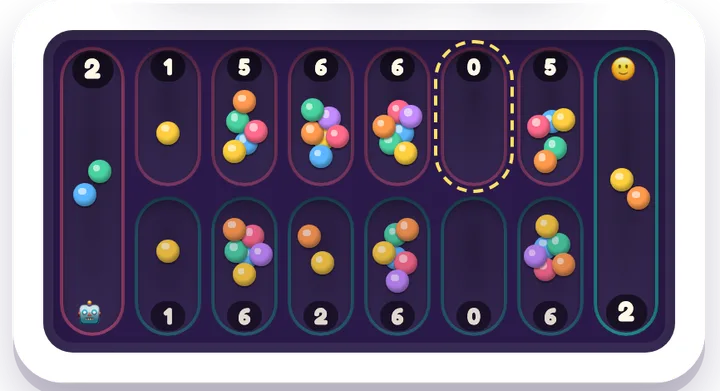
Mancala belongs to one of the oldest families of board games in the world, and at heart it's a counting game. Your child picks one of their pits, scoops up all its seeds and drops them one by one into the next pits; if the last seed lands in their big store, they go again. They play against the computer, which makes kid-sized mistakes on Easy. The counting suits a five-year-old perfectly, but the extra-turn and capture rules are easiest to learn with a grown-up alongside for the first few games, and Hint and Undo are there when they need them. Ours uses Kalah rules, and it's in the board games hub.
A little more challenge: Pattern Flash and Brick Bop (5+)
These two are great fun at five, but they bend the rules above, so here's exactly how:
- Pattern Flash lights up a few squares on a grid for a moment, then your child taps the same squares back, in any order. The squares only glow for a set time, and a wrong tap costs one of three lives; the game then shows where the squares were, so it feels like a lesson rather than a sting. Easy starts with three squares on a small 4×4 grid, and the Slower flashes setting gives little ones longer to look.
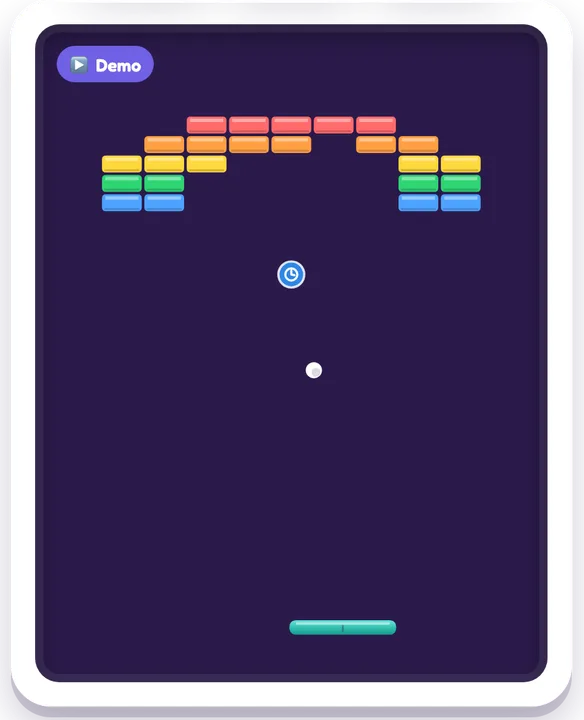
- Brick Bop is a paddle-and-ball game: slide the paddle, bounce the ball and break every brick. There are three lives, and one goes each time the ball falls past the paddle. Easy has the slowest ball and the widest paddle, and Hint marks where the ball will come down.
Pattern Flash sits with Memory Match and Simon in the memory games hub, and Brick Bop joins Snake and Bubble Shooter in the arcade games hub.
Gentle next steps (around age 6)
When your child is ready for a little more — usually around their sixth birthday — these are the natural step up. They're still forgiving and still need no reading to start, but they reward a bit more thinking:
- Candy Match — swap colourful candies to line up three or more; first real pattern-spotting.
- Block Puzzle — drag shapes onto a grid to fill rows; spatial thinking with no time pressure.
- Water Sort — pour the coloured liquids until each tube is one colour; calm, satisfying sorting logic.
- Mahjong Solitaire — clear the layout by matching free tiles; concentration and a little planning.
- Lot Shuffle — slide the cars and trucks along their lanes until the red car can drive out; every lot can be cleared, and Undo takes back a slide.
- Klotski — the classic sliding-block puzzle: shuffle the blocks until the big square escapes. The first layouts are short, and the famous classic one, saved for Expert, takes 81 moves.
Candy Match, Block Puzzle and Mahjong Solitaire live in the puzzle games hub, Water Sort in the logic games hub, and Lot Shuffle and Klotski in the spatial puzzles hub. And when your child gets a bit older, our free brain games for kids ages 7-9 picks up exactly where this list leaves off.
Why no ads, no accounts matters for this age
For a pre-reader, "no ads, no accounts" isn't about tidiness — it's about safety and independence. Here's why it matters more at four than at fourteen:
- Nothing to mis-tap. With no ad networks, there are no pop-ups, no auto-playing ad videos, and nothing unsuitable sitting in an ad slot. A wandering finger can't tap its way somewhere it shouldn't.
- No sign-up, no login. Your child opens a game and plays. There's no account to create, no password to remember, no email to hand over, and no chat with strangers.
- No tracking. No third-party trackers follow a child across the web, because there are no ad networks here to do the following.
- It just works. Every game runs in any browser on a phone, tablet, or laptop, it's friendly to low bandwidth, and there's a dark theme for evening wind-down before bed.
Put simply: there's no slot on the page for anything you didn't choose. That means you can hand over the tablet and actually walk into the next room. And if you want to keep an evening session short and predictable, the short, self-contained rounds in every pick above make "one more game, then we're done" an easy promise to keep — there's no escalating timer or rewarded-ad nudge trying to drag the session out. For the full why-it's-free and is-it-really-safe picture, our parents' guide to free, ad-free games lays it all out.
Start here
Pick any game above and let your child loose — there's nothing to set up and nothing to lose. When they're ready for more, the whole catalogue of free games is right there, sorted by age.
Ready to play? Browse all free games →