
Free Games to Practice Math Facts
By Jangul Aslam · Published 2026-06-07
The fastest way to put a kid off maths is to make it feel like another worksheet. The good news: some of the most popular number puzzles are quietly great practice — they build number sense, place value, and logical deduction without ever announcing themselves as "homework." Every one of them on iplay.free plays straight in the browser: free, ad-free, no sign-up, no download, nothing to buy.
A quick honesty note before we start. None of these are timed flashcards, and they won't drill times tables. Two of them — Number Smith and Box Split — do ask for real arithmetic, but as a puzzle you work out at your own pace: a clock counts up for bragging rights, nothing counts down. The rest build the thinking under the maths: doubling and place value, counting and deduction, planning a move ahead. That's the part that makes the arithmetic stick later, and it's the part a worksheet rarely reaches. A kid who enjoys reasoning with numbers will pick up the facts; a kid who's been drilled into dreading them often won't.
Think of these as the warm-up, not the workout. Five quiet minutes of a number puzzle after school does something a timed sheet can't: it lets a child be curious about numbers with no score and no pressure. Below are the six we'd reach for first, what each one quietly trains, and a few ways to nudge the maths along without it ever feeling like a lesson.
Real arithmetic, still a game
If you want actual sums — adding, taking away, times and divide — without a worksheet in sight, start here.
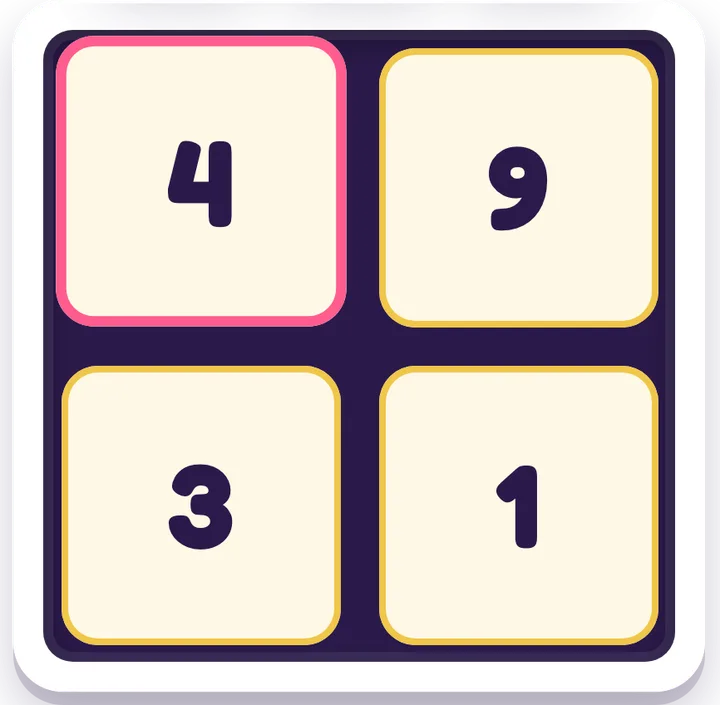
Number Smith hands your child four numbers and a target. Tap a number, tap + − × or ÷, tap another number, and the two join into their answer; keep going until one number is left. Use all four, each exactly once, and land on the target. Easy is Make 10, which is perfect for number bonds and a seven-year-old's first go. Medium is Make 24, the classic card-table puzzle. Hard is Tricky 24: those puzzles have just one or two ways in, and the trickiest need a fraction on the way. A wrong turn isn't a dead end — Undo steps back, Hint suggests the next join, and an optional helper tells you whether the target is still reachable from where you are. That turns "I got it wrong" into "let me try another way", which is most of what mental arithmetic is.
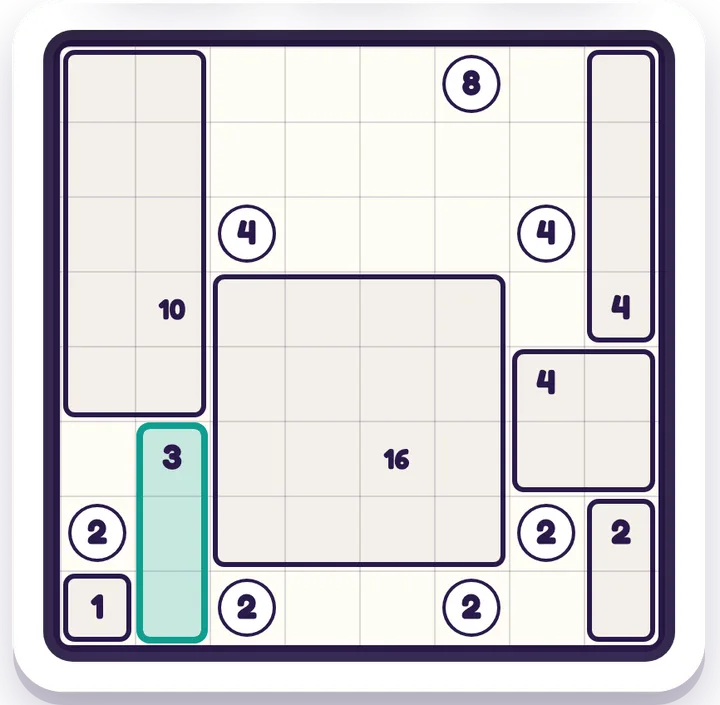
Box Split sneaks in multiplication and area. You split a grid into rectangles so that each box holds exactly one number — and that number is how many squares the box covers. A 6 could be 1 × 6 or 2 × 3; tap any number and the game shows its factor pairs (12 can be 1 × 12, 2 × 6 or 3 × 4) plus the boxes that still fit. Every puzzle has exactly one answer you can reason out without guessing, and the grids grow from 5 × 5 on Easy to 9 × 9 on Expert. It's the kind of times-table practice a child never notices they're doing.
Both are great from age 7 up and live in the math games hub, alongside 2048 and Sudoku.
2048: doubling, place value & planning
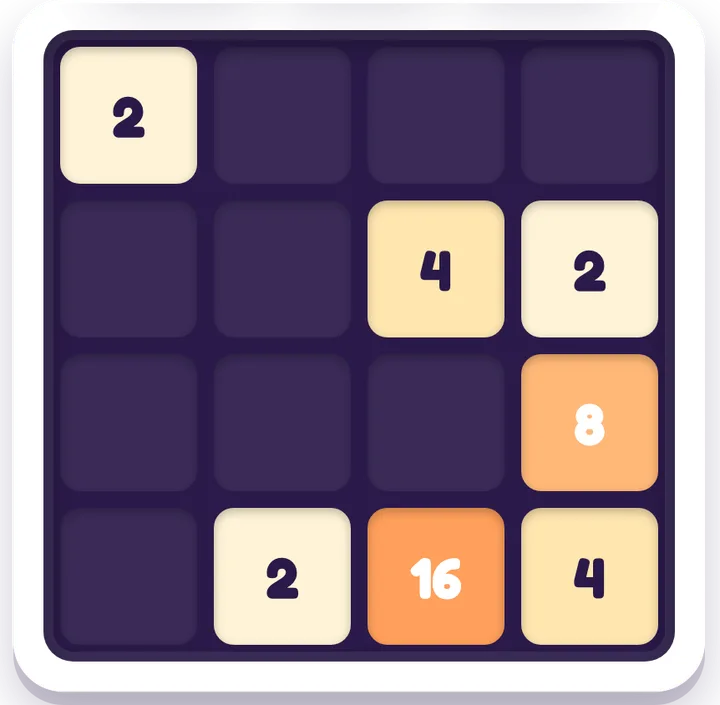
2048 is the number puzzle that has eaten many a commute. You slide all the tiles one direction, and when two equal numbers touch they merge into one worth double — two 2s make a 4, two 4s make an 8, and on up the chain. To do well you have to think a move ahead: where will the next tile land, and which merge keeps the board tidy?
That's real number work in disguise. Kids see the powers of two over and over (2, 4, 8, 16, 32, 64…) and start to feel how numbers double — the foundation of place value and, later, of multiplication. They also bump into a useful truth without being told it: the board doesn't grow when you play carelessly, it grows when you plan. Every careless swipe scatters tiles and clogs the grid; every thoughtful one sets up the next merge. That cause-and-effect — this move makes that outcome more likely — is the same reasoning that makes word problems click a few years on.
There are three board sizes to match the mood — Quick (3×3) for a fast game, Classic (4×4) for the real thing, Relaxed (5×5) for room to breathe — and an Undo button, which is the secret weapon for learning. Take a sloppy move back, try a tidier one, and compare: that little A/B test, repeated, is how a child works out why one move beat another instead of just hoping for a lucky tile.
If your kid gets hooked, our how-to-win 2048 guide walks through a simple corner strategy. It's great from age 8 up.
Sudoku: number logic & deduction
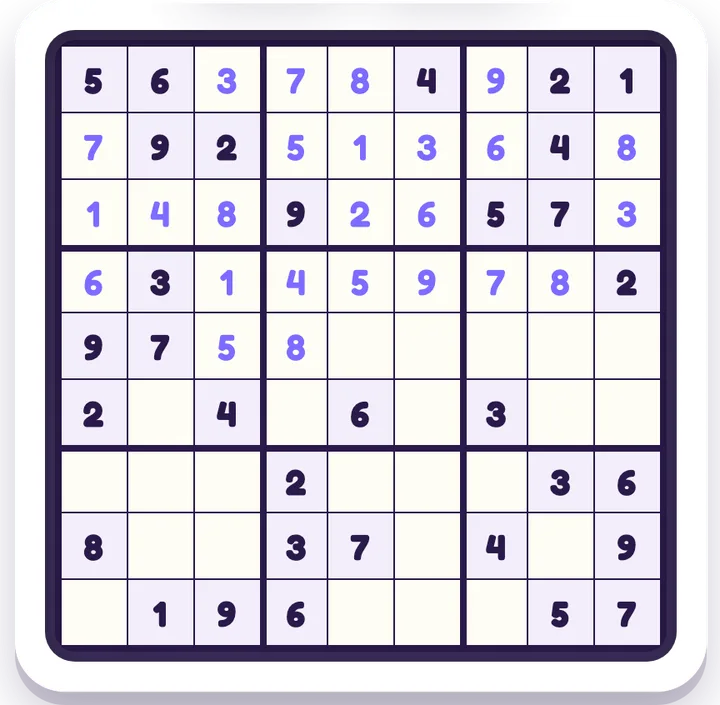
Here's the surprise about Sudoku: there's almost no arithmetic in it. You're placing the digits 1 to 9 so none repeats in a row, column, or box — and you get there by reasoning, not adding. "This box already has a 7, and so does that column, so the 7 here must go in the only square left." That's pure logical deduction, dressed up as numbers.
It's also wonderful patience training. A Sudoku rewards slowing down, checking your work, and resisting the urge to guess — exactly the habits that help with maths later, when one careless step quietly breaks an answer. And because the digits 1–9 are just symbols here, a child who finds arithmetic stressful can succeed at Sudoku purely on logic. That early win matters: it tells them numbers are something they can reason with, not just something they get wrong on a timer.
Start gentle. Easy boards leave plenty of given digits, so there's almost always an obvious next square — perfect for building confidence before you bump up the difficulty. There's a Hint button and easy/medium/hard levels, so a tricky grid never ends in tears, and our free Sudoku guide has a beginner-friendly walkthrough of the "only one square left" trick. Great from age 8 up.
Number-clue logic, too
Two more puzzles use numbers as clues rather than sums — both are terrific counting-and-deduction practice:
- Nonogram — the numbers along each row and column tell you how many squares to fill and in what runs; you count and deduce your way to a hidden picture (also called Picross).
- Minesweeper — each number tells you exactly how many mines touch that square. Read the numbers, reason out where the mines must be, and flag them. It's deduction under a little uncertainty.
Neither asks for arithmetic, but both make a kid read numbers carefully and draw conclusions from them — the same muscle Sudoku builds. Nonogram is especially good for younger solvers who like a payoff: every correct deduction reveals a bit more of a picture, so the reward is immediate and visual. Minesweeper leans a touch older, because some squares can't be solved by logic alone and you have to weigh the odds — a gentle first taste of probability. You'll find both filed under logic games, alongside the rest of the deduction puzzles, if your kid wants more in the same vein.
How parents can make it count
You don't need to turn play into a lesson — a few light prompts do the work:
- In Number Smith, think out loud about pairs. "We need 24 — what times what makes 24? Can we build a 6 and a 4 from these?" Working backwards from the target is the trick grown-ups use, and kids copy it fast.
- Narrate the doubling in 2048. "We've got two 16s next to each other — what do they make?" Suddenly powers of two are a game, not a table to memorise.
- Ask "what's the next merge?" Looking one move ahead is the whole skill in 2048, and it's exactly the planning you want in maths.
- In Sudoku, ask "how do you know?" Getting them to explain why a 7 goes there turns a placed digit into real reasoning out loud.
- Celebrate a clean solve. A finished Sudoku with no guessing, or a 2048 tile built without Undo, is a genuine win worth noticing — name the thinking you saw, not just the result.
- Play one yourself, out loud. Letting a child watch you reason through a Nonogram clue ("the clue says five, and there are only six squares, so these four in the middle are definitely filled") teaches deduction better than any instruction.
Keep it short and keep it playful. The aim is for maths to feel like something they're good at, not something they're being tested on. If a session is going badly, switch boards, drop the difficulty, or just stop — there's no streak to protect and nothing pestering them to keep going, so it's easy to leave on a high note.
At a glance
| Game | Great from | What it builds |
|---|---|---|
| Number Smith | 7+ | Mental arithmetic with + − × ÷, making 10 and 24 |
| Box Split | 7+ | Area, multiplication, factor pairs |
| 2048 | 8+ | Doubling, place value, planning a move ahead |
| Sudoku | 8+ | Number logic, deduction, patience |
| Nonogram | 8+ | Counting from clues, picture logic |
| Minesweeper | 8+ | Reading numbers, deduction under uncertainty |
Why these in particular
For maths practice, the calm matters as much as the puzzle. A child who's concentrating on a tricky Sudoku doesn't need a banner blinking beside the board or a pop-up between rounds breaking the focus. Here there are no ads to mis-tap, no pop-ups, no sign-up, and no ad trackers following your child — just the board. Everything runs in any browser on a phone, tablet or laptop, it's light on data so it works fine on a slow connection, and there's a dark theme for evening play. Most games include Hints, Watch-Solve and difficulty levels, so a hard board is a chance to learn rather than a dead end — and because nothing nags them to keep playing, five focused minutes can just be five focused minutes.
For the bigger picture, see our parents' guide to free, ad-free games, or pick by age with the ages 7–9 brain games and logic games for tweens.
Ready to make maths feel like play? Browse all free games →