Free Logic Puzzles You Can Play All Day
By Jangul Aslam · Published 2026-09-08
There's a particular kind of puzzle that's taken over people's mornings: a small grid, a couple of rules, and a solution you can reason your way to without ever guessing. One board, a few minutes, done. It's a good habit — and then the app tells you to come back tomorrow.
That daily limit makes sense for a newspaper. It makes less sense when you've just got the hang of the thing and want another one. And the free alternatives usually want something first: an account, an app install, or a screen with an ad banner sitting over the board.
iplay.free has three puzzles of exactly that kind, plus two close relatives further down — and you can play them as many times as you like. No ads, no sign-up, no download, nothing to buy.
Crown Grid — one crown per row, column and colour
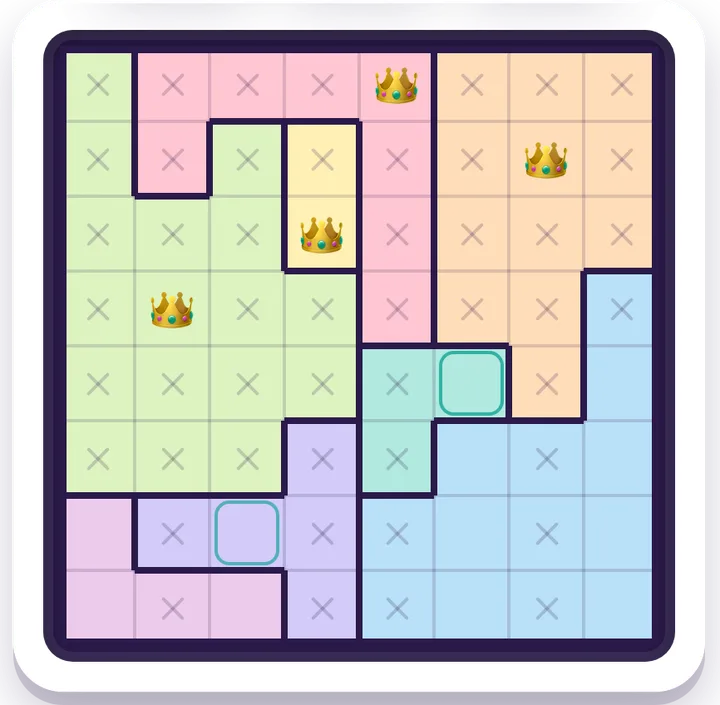
Crown Grid is the puzzle usually published as Star Battle. The board is split into coloured regions, and you place one crown in every row, every column and every region — with no two crowns touching, not even at a corner.
That last rule is the whole game. It sounds like a small restriction and it turns out to be enormous: a single crown quietly rules out eight neighbouring squares, and the chain of consequences runs right across the board. You mark the squares you've eliminated with an ✗, and the answer emerges from what's left.
It descends from the eight queens problem, set by the chess composer Max Bezzel in 1848 and later taken up by Carl Friedrich Gauss — a standard chessboard has exactly 92 solutions. Puzzle magazines added the colour regions much later, which is what turns a maths curiosity into something you can solve by reasoning alone.
Three sizes: 6×6 to start, then 8×8, then 9×9.
Sun & Moon — suns and moons in balance
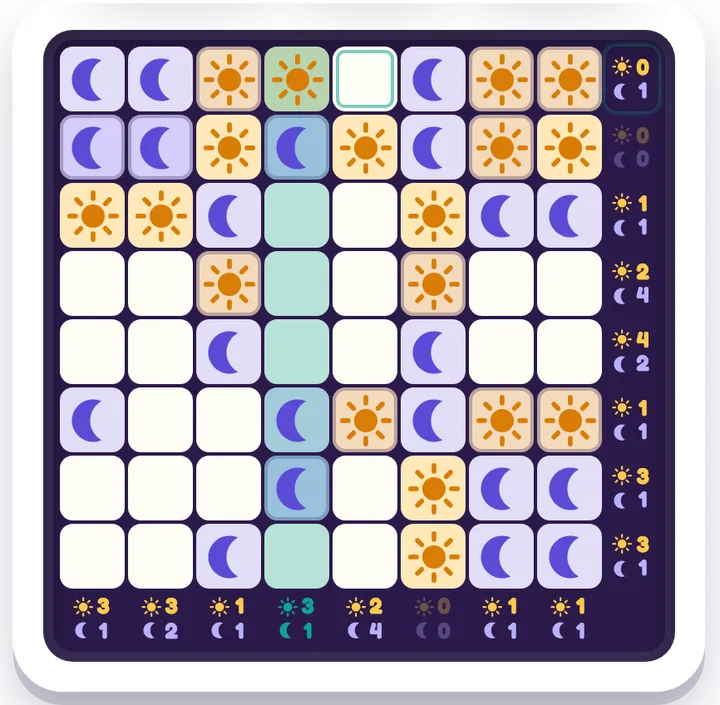
Sun & Moon is the binary puzzle, known as Takuzu or Binairo. Every square holds a sun or a moon, and three rules decide where they go: never three of the same in a row, an equal number of suns and moons in every line, and no two rows — or columns — identical.
It looks almost too simple, and then you meet the third rule. Two lines that are one square from matching force each other's hand, and suddenly a square on the far side of the board is decided. That's the moment the puzzle earns its keep.
The same even-or-odd counting that solves it is the reasoning behind the parity bit, the oldest trick computers use to notice that a bit has flipped in stored or transmitted data.
Three sizes: 6×6, 8×8 and 10×10.
Domino Fit — every shape has a rule
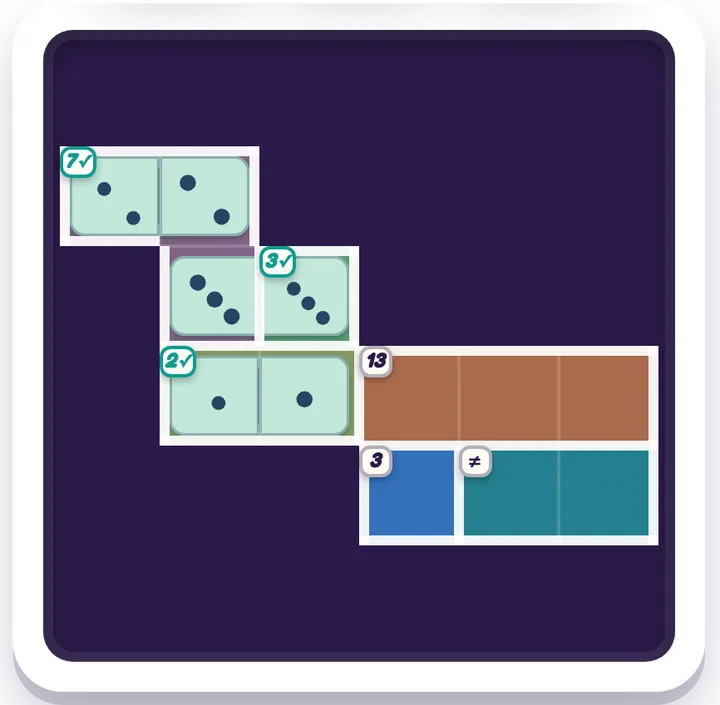
Domino Fit is the odd one out, and the one people seem to get stuck on happily. You get a board carved into coloured shapes and a tray of dominoes. Cover the board completely, using every domino once — and make each shape's rule come true. Some shapes must add up to a number. Some must show all the same number. Some must show all different ones.
Because a domino covers two squares at once, every piece you place is a decision about two shapes simultaneously. Turn a piece around and both halves change what they're contributing. It's the most tactile of the three: pick up a domino, turn it, drop it, take it back if it doesn't work.
Dominoes were being written about in China in the twelfth century and reached Europe around three hundred years ago, turning up in Italy in the 1700s. A double-six set holds 28 tiles — every pair of numbers from 0 to 6, exactly once.
Three tray sizes: 4 dominoes, then 6, then 7.
What all three have in common
You never have to guess. Every board in all three games was generated with a solver checking it, and only boards with exactly one solution — reachable by logic alone — made it in. If you're stuck, there is always something you haven't noticed yet. That's a promise the puzzle can keep, not a slogan.
The hints teach. Ask for a hint and it doesn't just drop an answer on the board — it tells you which rule forced it. "There is only one way left to finish column 1: never three alike, and the same number of suns as moons." Then it lights up that column so you can see the reasoning for yourself. It's the difference between being given a move and being shown one.
Watch Solve. If you'd rather see the whole thing unfold, Watch Solve plays the solution out step by step, in the order the logic actually runs. It's the fastest way to learn a puzzle you've never met.
No reading required. None of the three needs vocabulary or arithmetic beyond adding small numbers, which makes them unusually portable across ages — and they're translated into 12 languages, so a child can play in the language they think in.
Two more of the same kind
Two more puzzles on the site keep the same promise: one answer, reached by logic alone.
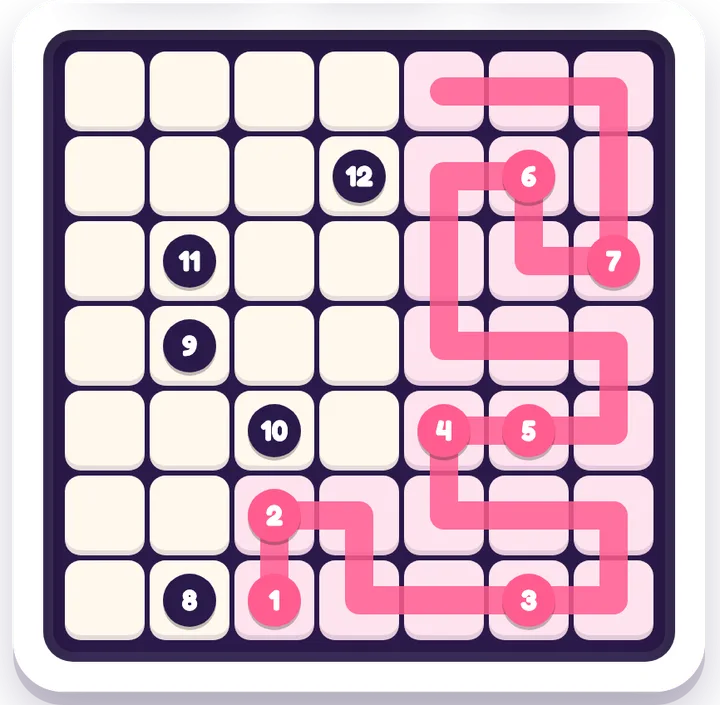
Number Thread is a single line. Start on 1 and drag up, down, left or right — never diagonally — so the thread passes through every square exactly once, meets the numbers in order and finishes on the highest one. A route that visits every square once is called a Hamiltonian path, after the mathematician William Rowan Hamilton, who turned the idea into a board game, the Icosian Game, in 1856. Four levels take the grid from 5×5 to 8×8.
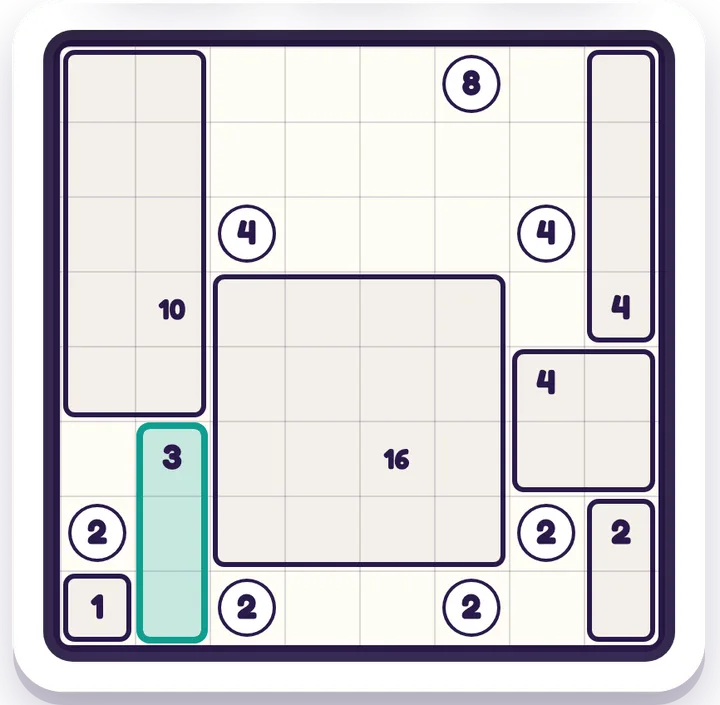
Box Split cuts the grid up instead. Split it into boxes — rectangles or squares — so that every box holds exactly one number, and that number is how many squares the box covers. Tap a number and it shows its factor pairs (12 can be 1 × 12, 2 × 6 or 3 × 4) along with the boxes that still fit. Puzzles of this kind were first printed in Japan in 1989 by the puzzle magazine Nikoli, under the name Shikaku. The grids run from 5×5 on Easy to 9×9 on Expert.
Both are built from puzzle packs that were generated and then checked by a separate verifier before release, so every puzzle has exactly one answer and none needs a guess. Both have Hint, Undo and Watch Solve — and, like the hints above, Box Split's Hint tells you why a box is forced.
Where to go next
Crown Grid, Sun & Moon, Domino Fit and Number Thread live in the logic games hub alongside the rest of the deduction puzzles — including Minesweeper and Nonogram, which scratch the same itch in different ways. If you like the no-guessing promise, Nonogram is the natural next one.
Sudoku and Box Split sit in the math games hub, where the same kind of reasoning comes with numbers attached.
Everything is free, everything runs in the browser, and nothing asks you to sign in.