How to Play Gomoku: Rules & Winning Tips
By Jangul Aslam · Published 2026-11-28
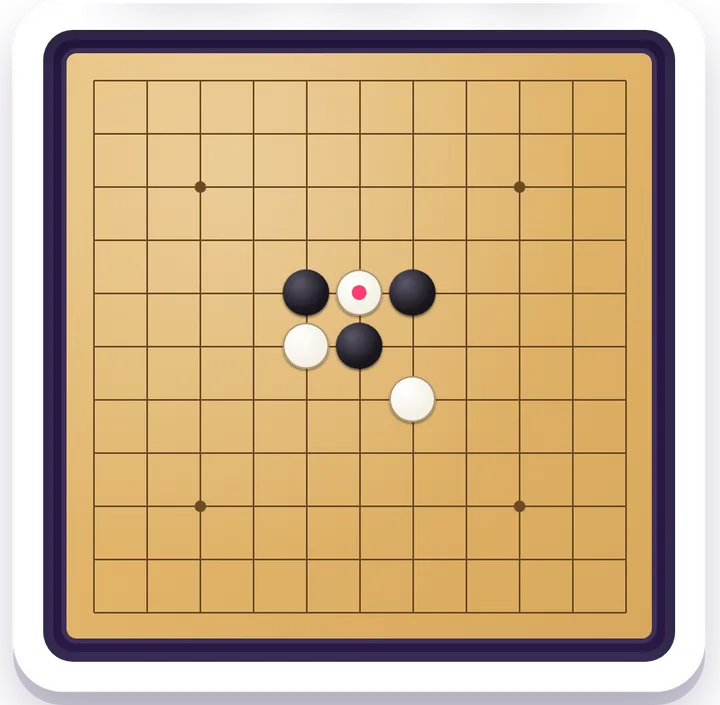
Gomoku is a two-player game of five in a row. Players take turns putting one stone of their colour on an empty point of a grid board, traditionally a 15×15 board. The first to get five stones in an unbroken line (across, down or diagonal) wins. Black always moves first, and stones never move once they are placed.
It takes a minute to learn and much longer to master, because every move both builds your own line and blocks your opponent's. This guide covers the rules, the shapes that decide most games, the main rule sets, and five tips for winning.
You can play freestyle gomoku free in Gomoku on iplay.free, against the computer, on an 11×11, 13×13 or 15×15 board, and you choose who starts. There are no ads, no sign-up and nothing to download, in 12 languages.
How to play gomoku: the rules
- The board. Stones go on the points where the lines cross, not inside the squares. Gomoku is often played with Go stones on a Go board.
- Black first. One player has black stones and the other white. Black moves first, then you take turns.
- One stone per turn. On your turn, put one stone on any empty point. Stones are never moved and never captured.
- Five wins. The first player with five of their stones in an unbroken row, across, up and down or on a diagonal, wins the game.
- A full board is a draw. If every point is filled and nobody has five, nobody wins.
That's the whole game in freestyle gomoku, the version iplay.free plays. In freestyle, a row of six or more counts as a win too.
Freestyle, standard gomoku and renju
The basic idea is always five in a row, but three common rule sets treat long rows and the first player differently:
| Freestyle gomoku | Standard gomoku | Renju | |
|---|---|---|---|
| Does six in a row win? | Yes | No: it must be exactly five | Not for black; white wins with six or more |
| Limits on black's moves | None | None | Black may not make a double three, a double four, or six or more in a row |
| Opening rules | None | None in casual play; tournaments use Swap2 | Set opening rules |
Freestyle is the simplest: five or more in a row wins, with no other limits. Standard gomoku only counts exactly five, and gomoku's world championships are played this way with the Swap2 opening. Renju is a separate tournament form. It gives black, the player who moves first, extra rules to limit its head start, and uses set opening rules. iplay.free plays freestyle.
The shapes to know: threes and fours
Most gomoku games are decided by a few shapes. Learn to spot them for both colours:
- Open three: three of your stones in a line, touching or with one gap, with enough empty points on both sides that one more stone makes an open four.
- Four: four of your stones within five points in a line (one gap is allowed), with one empty point left to make five. Your opponent must block that point at once.
- Open four: four in a row with both ends empty. There are two points that make five, and your opponent can only block one, so an open four wins.
- Four-three: one move that makes a four and an open three at the same time. Your opponent has to block the four, and the three then becomes an open four.
- Double three: one move that makes two open threes at once. Your opponent can only block one of them. (In renju, black isn't allowed to play it; in freestyle anyone can.)
The lesson: an open three is a real threat. If you leave one alone, you'll usually face an open four a move later, and that can't be stopped.
Five tips for winning
- Start near the middle. Stones in the centre have room to grow in every direction. Stones near the edge can be cut off.
- Block open threes early. Put a stone at one end of your opponent's open three before it grows. Waiting for a four is often too late.
- Build in more than one direction. Lines that cross give you the chance of a four-three or a double three, which your opponent can't block in one move.
- Use fours to take control. Every four forces a block. A chain of fours lets you choose where your opponent plays, while you set up the winning shape.
- Going first is a big help. Black has the advantage in gomoku. Once you can beat the computer easily, let it start for a tougher game.
Playing gomoku on iplay.free
You always play against the computer; there's no two-player mode. Each level has its own board size:
- Easy plays on a small 11×11 board and makes kid-sized mistakes.
- Medium plays on 13×13.
- Hard plays on the full 15×15 board and spots most traps.
In ⚙️ Settings you choose who goes first: you, the computer, or take turns. Whoever starts plays black. The dots under You and Computer show each side's longest unbroken row, so you can watch each line grow.
If you get stuck, ↩️ Undo takes back your last move, and ✨ Watch Demo lets the computer play both sides for a few moves to show how the game goes. It's a demo, not a solution. Beat the computer with no help for 3 stars. 💡 Hints, Undo and Watch Demo each count as help: up to 2 helps earns 2 stars, and more earns 1. You can also play with the keyboard: the arrow keys move around the board, and Enter or Space places your stone.
Is gomoku solved?
Yes, for the classic board with no opening rules. In 1994 the Dutch computer scientist Victor Allis used a computer program to prove that on a 15×15 board, in both freestyle and standard gomoku, the first player can always win with perfect play. Players knew black had a head start long before that, which is why renju, named in 1899, limits black. Tournament gomoku evens things out with opening rules such as Swap2, and those games are not solved.
The proof doesn't make the game easy for people. Nobody plays perfectly, and the smaller 11×11 and 13×13 boards on iplay.free were not part of it.
A little history
The game is best known by its Japanese name, 五目並べ (gomoku narabe, "five in a row"), and books about it date from the 1850s in Japan. Renju, meaning "connected pearls", got its name in 1899. In China the game is called 五子棋 (wǔzǐqí), and in Korea it's omok.
Quick answers
Does six in a row count in gomoku? In freestyle gomoku, yes: five or more in a row wins. In standard gomoku only exactly five counts, and in renju six doesn't win for black.
Who goes first in gomoku? Black always moves first. On iplay.free, whoever starts plays black, and you choose who starts in Settings.
Can the first player always win? With perfect play on a 15×15 board and no opening rules, yes, in both freestyle and standard gomoku: that was proved in 1994. In real games, mistakes decide the winner.
Is gomoku like tic-tac-toe? It's a bigger cousin. Instead of three in a row on a 3×3 grid, you need five in a row on a large board, which leaves room for real strategy.
Is gomoku the same as Go? No. They share the stones and the board, but in Go you surround territory and capture stones. In gomoku nothing is captured; you just race to five.
What age is gomoku for? Most children can learn it from about 6. On iplay.free, Easy (11×11) is a gentle first game, and Hard (15×15) is a real test for adults.
More board games
If you like strategy duels, Checkers offers American, Brazilian and Russian rules (see our checkers rules guide). Chess Puzzles starts with how each chess piece moves and builds up to checkmate in 1 and 2, and Mancala is sowing seeds by Kalah rules. All of them are in the board games hub. For more thinking games, see our logic games for tweens.
Ready for a game? Play Gomoku free → or browse all free games →