
Checkers Rules: American, Brazilian & Russian
By Jangul Aslam · Published 2026-11-28
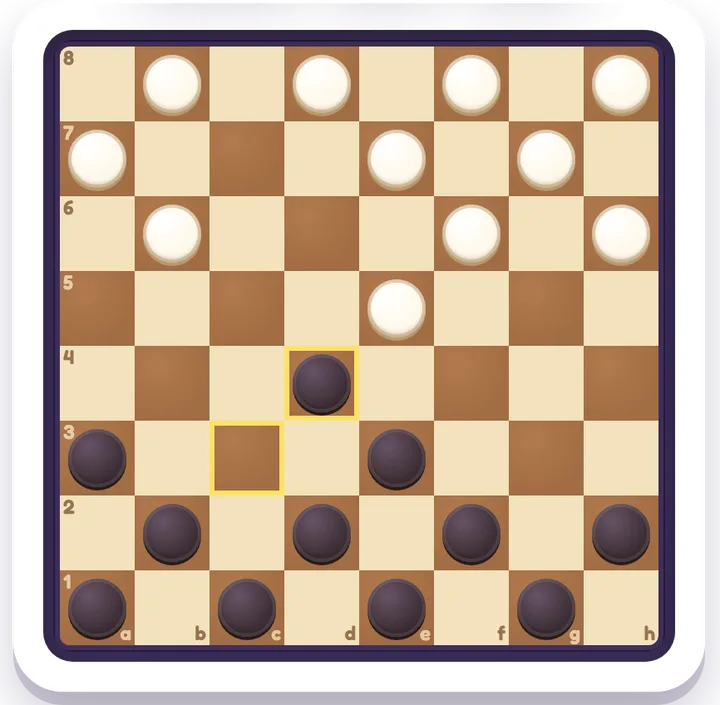
Checkers is a two-player game on the 32 dark squares of an 8×8 board. Each side starts with 12 pieces on the three rows nearest to it. Pieces move diagonally, you capture by jumping over an enemy piece, and a piece that reaches the far side becomes a king. You win by capturing all of the other side's pieces or leaving them with no move.
Those basics are shared by the three rule sets in this guide. The details are not: in some versions a plain piece can jump backward, kings can fly across the board, or you must take as many pieces as you can. That's why "checkers rules" can mean quite different games depending on where you learned. This guide explains the common rules first, then the three diagonal rule sets on an 8×8 board that you can play here, side by side.
You can play all three free in Checkers on iplay.free, against the computer: no ads, no sign-up and nothing to download, in 12 languages.
How to play checkers: the basic rules
- Moving. Plain pieces, called men, move one square diagonally forward onto an empty dark square.
- Jumping. If an enemy piece is diagonally next to yours and the square just behind it is empty, you jump over it and it is captured.
- Jumping is not optional. If you can jump, you must. That rule is the heart of the game: it lets a good player force the other side into a trap.
- Keep jumping. After a jump, if the same piece can jump again, it keeps going in the same turn. That's a double or triple jump.
- Kings. A man that reaches the far row is crowned king. Kings can move backward as well as forward.
- Winning. Capture every enemy piece, or block them so they cannot move.
In iplay.free's Checkers you tap your piece, then tap one of the dots that shows where it can go. For a double jump you tap each landing square in turn, or the ringed square where the jump finishes.
American, Brazilian and Russian rules side by side
| American | Brazilian | Russian | |
|---|---|---|---|
| Also called | English draughts | International rules on an 8×8 board | Russian draughts |
| Who moves first | Dark | Light | Light |
| Can men jump backward? | No | Yes | Yes |
| How far can a king move? | One square | Any distance (flying kings) | Any distance (flying kings) |
| Several jumps possible? | Pick any of them | Must take the way that captures the most pieces | Pick any of them |
| Crowned mid-jump, keeps jumping? | No: it's crowned, and the move ends | No: only if the piece ends its move on the far row | Yes: it becomes a king at once and keeps jumping as one |
American rules (English draughts) are the simplest of the three: men only ever move and jump forward, and a king moves one square at a time in any diagonal direction. When you have a choice of jumps, you may pick any of them.
Brazilian rules are the international rules played on the smaller 8×8 board. Men can jump backward, and kings fly: they move any distance along a diagonal and can jump a piece far away, landing on any empty square beyond it. When there is more than one way to capture, you must take the way that captures the most pieces, and kings and men count the same.
Russian rules also have backward jumps and flying kings, but you may choose any capture, not only the biggest one. The special Russian rule is crowning in the middle of a jump: a man that reaches the far row during a jump becomes a king immediately and carries on jumping as a king.
One rule catches people out in both flying-king sets: if a king can keep jumping from one of the squares beyond the piece it took, it must land there and keep going.
When is it a draw?
Here are the draw rules iplay.free uses. All three call a draw when the same position comes up three times; they differ on long games with no progress:
- American: after 40 moves each with no jump and no man moving.
- Brazilian (the Brazilian federation's rules): after 20 king moves each with no jump and no man moving, or after 5 moves each in a few small endings, such as 2 kings against 1 king.
- Russian: after 15 king moves each with no jump and no man moving, or when only a few pieces are left and nothing changes for a while, for example 3 kings that can't catch a lone king in 15 moves.
Which rules does iplay.free use?
Checkers picks a rule set from the site language, so it starts on the set closest to the rules usually played in that language: Russian in Russian; Brazilian in Spanish, Portuguese, Arabic, French, German, Turkish and Chinese; and American in English, Hindi, Japanese and Italian. You can switch rule sets any time in ⚙️ Settings, which starts a new game.
Settings also let you choose who goes first: you, the computer, or take turns. Whoever starts plays the first colour, which is dark in American rules and light in Brazilian and Russian rules.
Five tips for beginners
- Keep your back row as long as you can. The other side can only crown a king on your back row. Pieces left there stop that from happening.
- Head for the middle. Pieces in the center have more ways to move and are harder to trap than pieces stuck on the edge.
- Use the must-jump rule. Offer one piece so that the other side has to jump, and set it up so you can jump back over two. It's a classic checkers trap.
- Move in pairs. A friend on the square diagonally behind a piece blocks any jump along that line, because there's no empty square to land on. Cover both squares behind it and it can't be jumped from the front.
- With flying kings, crown first. In Brazilian and Russian rules a king can cross the whole board, so getting the first king often decides the game.
How the game helps you learn
You always play against the computer; there's no two-player mode. Easy makes kid-sized mistakes, Hard thinks many moves ahead, and Medium sits in between. While you play:
- 💡 Hint suggests a good move.
- ↩️ Undo takes back your last move.
- ✨ Watch Demo lets the computer play both sides for a few moves to show how the game goes. It's a demo, not a solution.
- Helpers can show which pieces can move, a glow when you must jump, and the last move played. You can switch them off in Settings.
Beat the computer with no help for 3 stars. Hints, Undo and Watch Demo each count as help: up to 2 helps earns 2 stars, and more earns 1.
A little history
Checkers grew out of alquerque, an older jumping game, when players moved it onto a chessboard in medieval Europe. In 2007 a team of Canadian computer scientists proved that a game of American checkers always ends in a draw if neither player ever makes a mistake.
Quick answers
Do you have to jump in checkers? Yes. In American, Brazilian and Russian rules alike, if you can capture, you must.
Can a regular piece jump backward? Not in American rules. In Brazilian and Russian rules, men can jump backward, though they still move forward only.
Can a king move more than one square? In American rules a king moves one square at a time. In Brazilian and Russian rules kings fly: any distance along a diagonal.
Who moves first in checkers? Dark moves first in American rules; light moves first in Brazilian and Russian rules.
Are checkers and draughts the same game? Yes. Draughts is the British name, and English draughts is the same game as American checkers.
What age is it for? From about 6. Easy is gentle enough for a first game, and Hard is a real test for adults.
More board games
When you're ready for the next step, Chess Puzzles starts with how each chess piece moves and builds up to checkmate in 1 and 2. Gomoku is five in a row on a big board (how to play Gomoku), and Mancala is sowing seeds by Kalah rules. All of them are in the board games hub. For more thinking games, see our logic games for tweens.
Ready for a game? Play Checkers free → or browse all free games →