
Killer Sudoku: Rules, Tips & a Kid-Size 4×4 Start
By Jangul Aslam · Published 2026-11-28
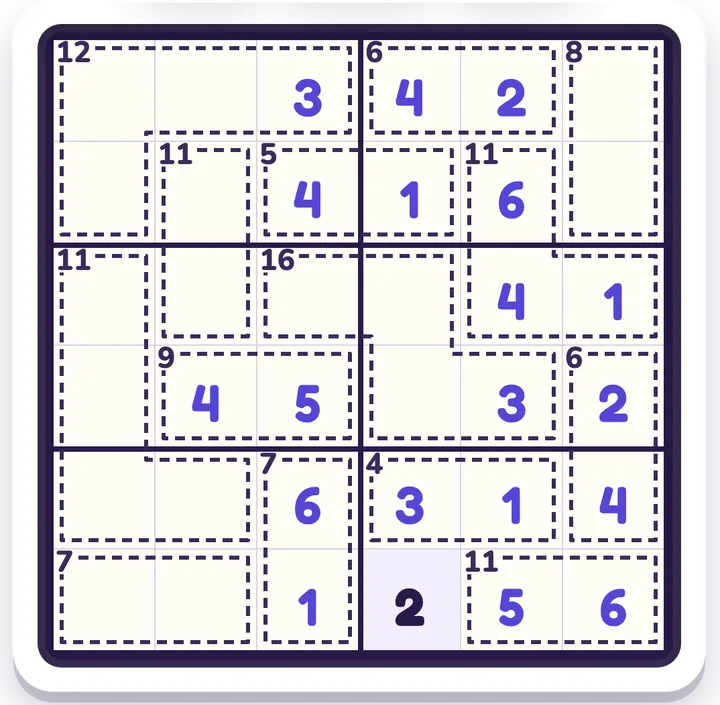
Killer sudoku is sudoku with addition. The grid is split into dashed shapes called cages, and the numbers in each cage must add up to the small number printed in its corner. A number can't repeat inside a cage, and every row, column and box still holds each number exactly once.
That's the whole game. It sounds harder than ordinary sudoku, and on a big grid it can be, but the cages also hand you clues a normal sudoku never gives. Once you know the two tricks below, a puzzle starts to open up one square at a time.
You can play it free on iplay.free as Sum Cage Sudoku: no ads, no sign-up and nothing to download, in 12 languages. It starts on a small 4×4 grid that a seven-year-old can finish, and grows to the full 9×9. (We call it Sum Cage Sudoku because a lot of our players are kids, but it is the same puzzle grown-ups know as killer sudoku.)
Killer sudoku rules in 30 seconds
- Fill every square so each row, column and box has each number once: 1 to 4 on a 4×4 grid, 1 to 6 on 6×6, and 1 to 9 on 9×9.
- Make every cage add up. The numbers inside a dashed cage add up to the little number in its corner.
- No repeats in a cage. A cage that needs 4 in two squares is 1 + 3, never 2 + 2.
In Sum Cage Sudoku you tap a square, then tap a number. Turn on ✏️ Notes to pencil in maybe-numbers, and ↩️ Undo takes back your last change.
Start small: the 4×4 grid
A full 9×9 killer sudoku is a steep first step. Starting small makes the rules click:
| Level | Grid | Numbers | Every row, column and box adds up to |
|---|---|---|---|
| Easy | 4×4, then 6×6 | 1–4, 1–6 | 10, 21 |
| Medium | 6×6 | 1–6 | 21 |
| Hard | 9×9 | 1–9 | 45 |
| Expert | 9×9, with bigger cages | 1–9 | 45 |
The very first Easy puzzle teaches the idea with a cage that is already partly filled: it needs 6, it already has 2, so what's missing? That little "6 − 2 = 4" is the move you'll use more than any other. Tap any square and the helper line under the grid shows its cage as a sum, such as 2 + ? = 6, so younger players can see the subtraction instead of holding it in their heads. Once you don't need the extra help, the Helpers switch in Settings turns off the clash marks and the "Could be:" list of ways to fill a cage; the sum line stays.
Sum Cage Sudoku is recommended from age 7: the 4×4 grids for the youngest, and 9×9 from about 9.
Trick 1: cages that can be made only one way
Some cage sums have exactly one possible set of numbers. A two-square cage that needs 3 can only be 1 and 2. A two-square cage that needs 17 can only be 8 and 9. You don't know which square gets which number yet, but you know which two numbers live there, and that rules them out of the rest of any row, column or box that holds both squares.
These are the one-way sums worth learning for the full 9×9 grid (numbers 1 to 9):
| Cage size | One way only |
|---|---|
| 2 squares | 3 = 1+2 · 4 = 1+3 · 16 = 7+9 · 17 = 8+9 |
| 3 squares | 6 = 1+2+3 · 7 = 1+2+4 · 23 = 6+8+9 · 24 = 7+8+9 |
| 4 squares | 10 = 1+2+3+4 · 11 = 1+2+3+5 · 29 = 5+7+8+9 · 30 = 6+7+8+9 |
| 5 squares | 15 = 1+2+3+4+5 · 16 = 1+2+3+4+6 · 34 = 4+6+7+8+9 · 35 = 5+6+7+8+9 |
| 6 squares | 21 = 1+2+3+4+5+6 · 22 = 1+2+3+4+5+7 · 38 = 3+5+6+7+8+9 · 39 = 4+5+6+7+8+9 |
Notice the pattern: the smallest and largest sums for each cage size are the one-way ones. On the small grids the list changes, because the numbers stop at 4 or 6:
| Grid | One way only |
|---|---|
| 4×4 | 2 squares: 3, 4, 6 and 7 (only 5 has two ways) · every 3-square cage · 4 squares: 10 |
| 6×6 | 2 squares: 3, 4, 10, 11 · 3 squares: 6, 7, 14, 15 · 4 squares: 10, 11, 17, 18 · every 5-square cage |
The game's hints use this trick by name ("can be made only one way"), so when you ask for help you learn the reason, not just the answer.
Trick 2: the rule of 45 (and 10, and 21)
The numbers 1 to 9 add up to 45, so every row, column and box on a 9×9 grid adds up to 45. That gives you a way in when the cages don't line up neatly with a row or box.
Say the cages that sit completely inside one box add up to 38, and exactly one square of that box is left over, belonging to a cage that crosses into the next box. That leftover square must be 45 − 38 = 7. Puzzle solvers call it the rule of 45, and the squares left over (or sticking out) are often called innies and outies.
The same trick works on the small grids with smaller totals: 1 to 4 adds up to 10 and 1 to 6 to 21. Sum Cage Sudoku introduces it gently, with the 21 rule partway through Medium, single leftover squares on Hard, and two or three leftover squares that add up to a total together on Expert.
Six tips for your first 9×9
- Look for one-way cages first. Small sums (3 or 4 in two squares, 6 or 7 in three) and big ones (16 or 17 in two squares, 23 or 24 in three) are your best starting points.
- Finish nearly full cages. A three-square cage that needs 15 and already has 6 and 4 is missing a 5.
- Pencil in pairs. When a two-square cage can only be 1 and 2, note both numbers in both squares. Those two numbers are now gone from the rest of any row, column or box that holds both squares.
- List the ways. A three-square cage that needs 8 is 1+2+5 or 1+3+4. Cross out any way that clashes with its row, column or box, and the cage often narrows to one.
- Count a box when you're stuck. Add up the cages that fit completely inside a box and see what's left over from 45.
- Ask a hint that explains. A hint first takes out any numbers that aren't right, then fills one square and says why. On Hard and Expert the first press only lights up where to look, so you can try the step yourself.
How hints and stars work
Wrong tries never cost stars. Stars count help instead: a puzzle with no hints earns 3 stars, one or two presses of 💡 Hint earn 2 (on Hard and Expert one full hint takes two presses), and three or more, or ✨ Watch Solve, earn 1. Watch Solve fills the grid in the order a solver would, with the reminder that every number has a reason.
There's no clock on screen while you play, no lives and no mistake counter, so a slow, careful solve feels as good as a quick one. Every puzzle has exactly one answer, and every square can be worked out by logic: an independent solver checks each puzzle before the game ships, so you never need to guess.
Where the name comes from
The puzzle's Japanese name comes from the English words "sum number place". The Times, a London newspaper, brought it to its readers in 2005.
Quick answers
Is killer sudoku harder than regular sudoku? On a 9×9 grid it usually starts with fewer numbers filled in, so it can feel harder at first. The cage sums give you extra clues, though, and many players find the adding makes it more fun. Starting on 4×4 or 6×6 is the easiest way to learn.
What do the dashed lines mean? Each dashed shape is a cage. The numbers inside it add up to the small number in its corner, and no number repeats inside it.
Does every puzzle have one answer? Yes. Every Sum Cage Sudoku puzzle has exactly one answer, reachable by logic alone, and each one is checked by an independent solver before it ships.
What age is it for? From 7: kids start on 4×4 grids with the numbers 1 to 4, and the 9×9 levels suit most players from about 9 up, adults included.
Is it free? Yes. No ads, no sign-up, nothing to buy and nothing to download. It plays in any browser on a phone, tablet or computer.
More number puzzles
If you like the logic, try classic Sudoku, the cage-free original; 2048, where you slide and merge tiles that double; Box Split, where you split the grid into boxes so each number is its box's size; and Number Smith, which asks you to join four numbers with + − × ÷ to hit a target. They all live in the math games hub. For more on the original, read our guide to free Sudoku online, or see free games to practice math facts.
Ready to try a cage? Play Sum Cage Sudoku free → or browse all free games →