Free Games That Build Memory & Focus
By Jangul Aslam · Published 2026-09-27
"Where was the other giraffe?" If you've ever played a card-matching game with a small child, you've watched memory being worked in real time: the pause, the squint, the hand hovering over two cards, then the flip. Some of the best games for building memory and focus are also some of the oldest and simplest.
They're also the easiest to ruin. A game that stops every few rounds to show an ad, or pesters a child to come back tomorrow, is training the opposite of focus. So everything in this post plays free on iplay.free with no ads, no pop-ups, no sign-up and nothing to buy. Open it and play, and nothing interrupts.
First, an honest word about "brain training"
These games exercise memory and attention while you play them. Whether that makes anyone better at unrelated things, like spelling tests or remembering where they left their shoes, is something researchers still argue about, and we won't pretend otherwise.
Our claim is more modest and easier to stand behind. Holding things in mind and sticking with a task are skills, and skills get easier with practice. These games are a pleasant, pressure-free way to practice both, which is more than most screens can say.
Memory and focus are two different muscles
It helps to separate them, because different games work each one.
- Working memory is holding a few things in your head while you use them. Where was that fox card? What were the last four colors? It's the mental sticky note.
- Focus, or sustained attention, is staying with one task and filtering out distractions. It's scanning a grid for the last hidden word when everything in you wants to give up.
The first few games below lean on memory, and the later ones lean on focus. The best of them ask for both.
Memory Match: the classic concentration game
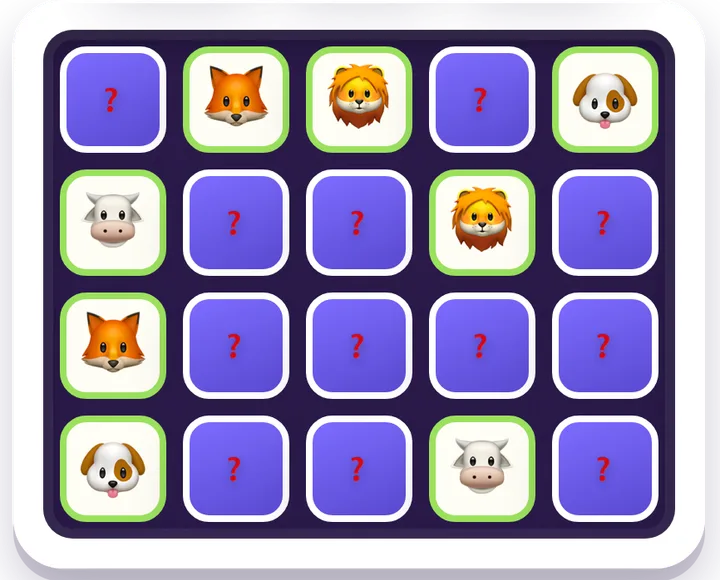
Memory Match is the card game almost everyone learned first. Flip two cards; if the pictures match, they stay face up, and if not, they flip back, so you'd better remember what you saw. It's great from age 4 up.
It scales beautifully. There are five board sizes, from a Warm-up of just 3 pairs to an Expert board of 18, so a preschooler and a grandparent can both find their level. For younger players there's an optional quick peek that shows every card for about a second as a round begins, plus a Peek button for when they get stuck. It's a gentle way to learn the idea, and easy to switch off once they're ready for the real challenge.
The game counts your tries and awards up to three stars for clearing the board in fewer of them. That turns out to be a great motivator, because it rewards careful remembering over random flipping.
Tip: encourage kids to say the picture out loud when a card flips ("Penguin, top corner"). Naming things and tying them to a location is one of the simplest memory tricks there is, and it works for adults too.
Simon: remember the sequence
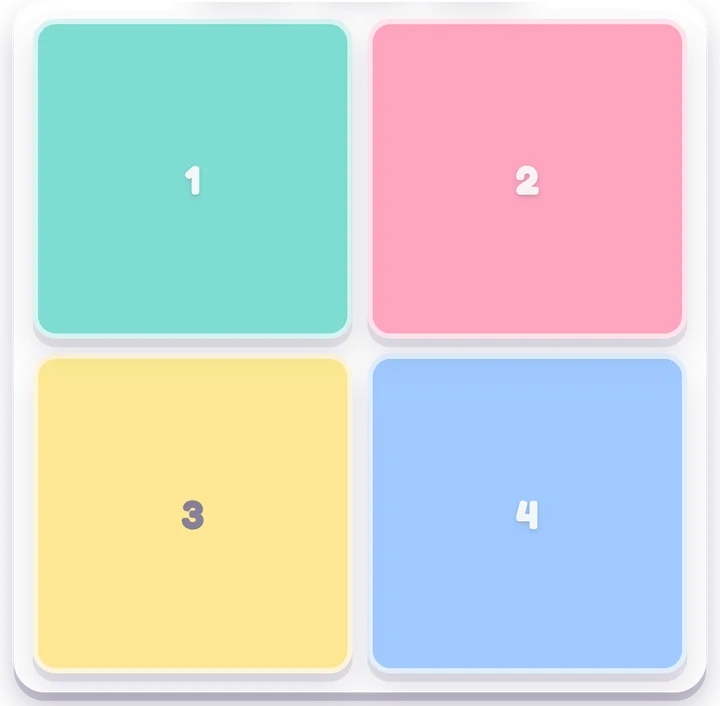
Simon is our browser version of the classic electronic memory game that became a hit in 1978. The pads light up in a pattern, you repeat it, and each round adds one more step. It's a pure test of sequence memory and great from age 5 up.
There are three speeds (Easy, Medium and Fast), and a setting that shows numbers on the pads. The numbers are a clever scaffold: some children remember "1, 3, 2, 4" more easily than four colors, and once the pattern clicks you can switch them off again.
Tip: teach chunking. Instead of one long string of eight steps, remember it as two groups of four. With the numbers switched on, that's "2-4-4-1, then 3-2-1-1". It's the same trick we all use for phone numbers, and Simon makes it tangible. Fair warning to grown-ups: Fast speed is humbling.
Both games live in the memory games hub.
Memory with meaning: facts that stick
Matching gets more interesting when the pairs mean something.
- Soccer Champions Match (7+) asks players to link each men's World Cup year to the nation that won it. Some countries won more than once, so several years point to the same flag. That's genuine recall with a little history attached. It's part of the sports hub.
- Flag Guess (7+) is recall practice for the whole world, from famous flags on Easy to all 194 countries on Hard, where you type the answer yourself.
Focus: games that reward staying with it
These lean less on memory and more on attention: scanning, sticking with a search, and not giving up on a tricky board.
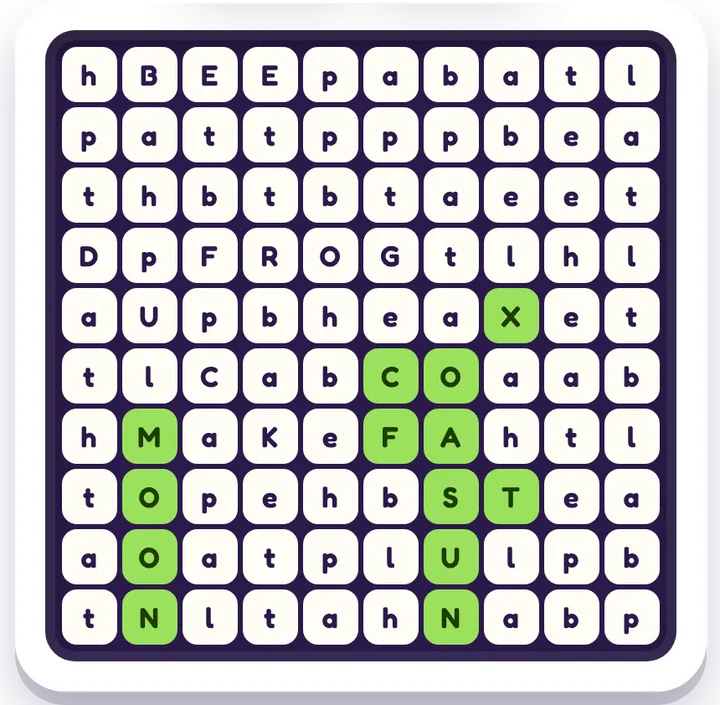
- Word Search (6+) is sustained visual scanning. Bigger grids hide more words, the harder levels add diagonal and backwards ones, and there's an optional helper that highlights first letters when attention flags.
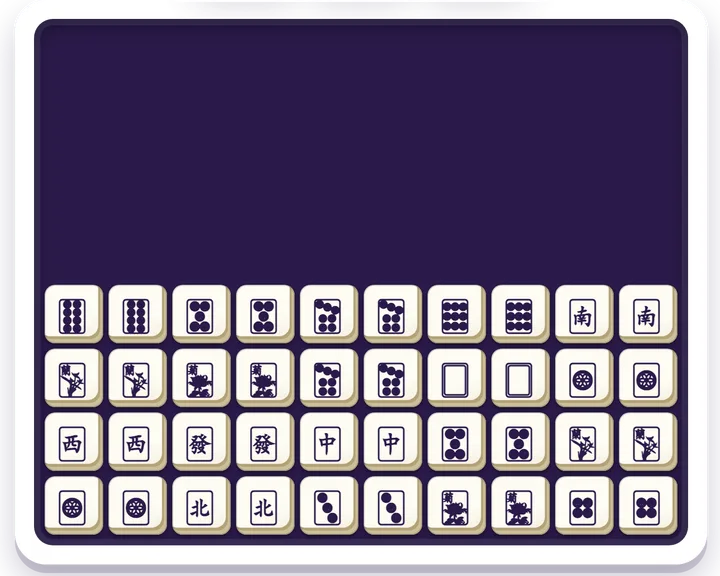
- Mahjong Connect (6+) asks you to find two matching tiles that can be joined by a path with no more than two turns. You have to hold the tile you're hunting for in mind while scanning a busy board, which uses memory and focus together.
- Nonogram and Sudoku (8+) are the long-focus puzzles. The bigger Nonogram grids and the harder Sudoku levels ask for a good stretch of quiet, careful attention, and a hidden picture or a completed grid is the reward.
You'll find more in the word games, puzzle and logic hubs.
At a glance
| Game | Great from | Mostly trains |
|---|---|---|
| Memory Match | 4+ | Working memory, visual recall |
| Simon | 5+ | Sequence memory |
| Word Search | 6+ | Visual scanning, sustained focus |
| Mahjong Connect | 6+ | Visual search plus memory |
| Soccer Champions Match | 7+ | Fact recall |
| Flag Guess | 7+ | Fact recall |
| Nonogram | 8+ | Long, careful focus |
How to make practice count
- Start small and level up slowly. Move to a bigger Memory Match board or a faster Simon only after a clean round at the current one. Success is what keeps a child coming back.
- Keep sessions short. Ten focused minutes beats forty distracted ones. Stop while it's still fun.
- Play together. Take turns on the same Memory Match board and keep score on paper, one pair each per turn. It's the original party version, and watching someone else's flips is its own memory workout.
- Talk about strategy, not scores. "How did you remember that one?" teaches more than "you got 12."
- Use it as a warm-up. A few minutes of Simon before homework is a good way to switch into concentration mode.
Why it matters that nothing interrupts
Concentration is fragile. That's the practical reason these games run with no ads, no pop-ups, no notifications and nothing to buy: when a child is holding four colors in their head, a banner sliding in is enough to lose all four. Everything runs in the browser on phones, tablets and laptops, there's nothing to download, and nothing nags them to keep playing, so ten minutes can simply be ten minutes.
If you're choosing by age, our guides to the best free games for ages 4–6 and brain games for ages 7–9 are good next reads, and screen-time-friendly games covers the bigger picture. Teachers: see our no-login classroom games guide.
Ready for a round? Browse all free games →